04 / WHAT CHANGED IN HUMAN SKIN AND CELLS
Copper peptide skin research: what GHK-Cu changed
You’ll see tests in people, removed skin, and cells. You’ll also learn why a serum may not reach the deeper skin.
What copper peptide skin studies found
Loren Pickart's later work asked whether GHK-Cu could help worn skin rebuild. The dish amount ran from one among 10 multiplied by itself 12 times to one among 10 multiplied 11 times. The best result came near one among 10 multiplied 9 times [1]. More collagen came from each cell, but nobody's face was part of this test.
A broad review found added padding around skin cells [3]. Small skin trials reported firmer, clearer skin and softer lines. Some used a placebo, which was a plain look-alike cream. Since those trials were small, they can't give you a sure size or timing for a gain.
Another team used a 1:9 mix of GHK-Cu and hyaluronic acid. That means one part GHK-Cu with nine parts of a gel that helps your skin hold water. Anchoring collagen rose 25.4-fold in cells [7]. It rose 2.03-fold in skin removed from the body for testing.
These results may explain what a copper peptide does for skin. They don't prove that a serum reaches those same cells in you. Collagen made in dishes was the clearest result. The human changes in lines and firmness were measured with less care.
What a copper peptide changed in skin
After GHK-Cu was added, skin cells produced extra collagen, elastin, and soft padding [3]. A mix with hyaluronic acid raised anchoring collagen 25.4-fold in cells. Removed skin showed a 2.03-fold rise [7]. These lab findings hint at deeper repair without promising any change in your face.
What a copper peptide may do for your skin
Dish tests found more collagen and two parts of the padding around cells [3]. A mix of GHK-Cu and hyaluronic acid raised anchoring collagen in cells and removed skin [7]. Small tests with placebo creams found softer wrinkles and firmer skin [3]. Dish cells aren't a whole face, so your result may differ.
Whether GHK-Cu truly raises collagen
Skin cells made collagen from one part among 10 multiplied by itself 12 times to one among 10 multiplied 11 times. The best result came near one among 10 multiplied 9 times [1]. Cell numbers didn't rise, so each cell did more. Pickart also reviewed skin tests with more new collagen [3].
What copper peptide vs retinol studies found
Researchers wanted to compare GHK-Cu with common skin treatments. A Pickart review from 2015 gives the clearest numbers. Collagen rose in 70% of women using GHK-Cu. It rose in 50% using vitamin C and 40% using retinoic acid, a vitamin A treatment [3].
A 2025 review repeated the same 70%, 50%, and 40% figures [11]. The review also warned that outer skin keeps much of GHK out. Poor entry makes any claim about deeper skin less sure for you. One review isn't equal to several fair head-to-head trials.
GHK-Cu tells skin cells to add support beneath the surface. Retinol and retinoic acid are vitamin A treatments that change how those cells grow. The few trials can't prove which choice would serve your skin better. The GHK-Cu vs retinol in the research gives one comparison, not a final answer.
Whether GHK-Cu worked better than retinol
The Pickart 2015 review found more collagen in 70% of women using GHK-Cu. Retinoic acid, a vitamin A skin treatment, showed the change in 40% [3]. The two treatments affect cells in different ways. This lone comparison can't prove which is better for you.
What the copper peptide vs retinol numbers mean
One comparison found more new collagen in 70% using GHK-Cu. The figures were 50% for vitamin C and 40% for retinoic acid, a vitamin A skin treatment [3]. A 2025 review repeated them but warned that GHK enters skin poorly [11]. These figures don't settle which treatment will work best for your skin.

What copper peptide serum benefits depend on
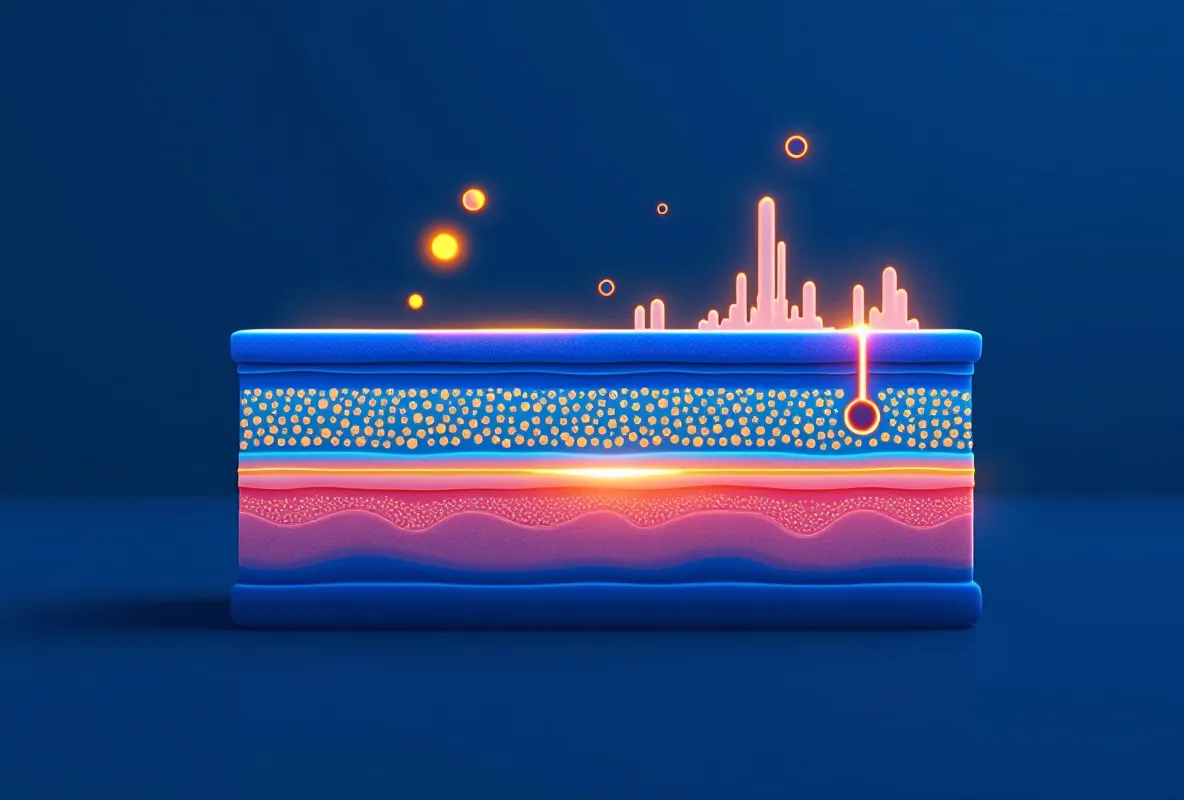
Serum researchers wanted to move GHK-Cu past the tough outer skin. GHK mixes with water so well that skin shuts most of it out [11]. Little may reach the deeper cells tested in dishes. That makes a cream claim less sure.
In removed human skin, 97 micrograms stayed in each square centimeter after 48 hours, or 2 days [5]. The paper wrote a slow rate as 2.43 x 10^-4 centimeters per hour, or about two ten-thousandths. Some copper crossed and some remained. Removed skin can't show what daily use does.
Researchers tried tiny needles and fat-like bubbles to help GHK-Cu pass [11]. The bubbles were about 100 nanometers wide, far too small to see. They held 31.7%, about one third, for 4 weeks. In skin cells, they cut a harmful enzyme by 48.9% without killing the cells [8].
The best entry results used help to cross skin. Plain watery GHK-Cu may stay near the surface. How a serum is made may matter. Still, these tests don't tell you which product will work.
What else to watch for on your skin
Three skin questions come up often. Each answer tells you what was tested. None gives you a personal treatment plan.
How long GHK-Cu skin tightening took
No fair trial tracked skin firmness on a set clock. Dish work found more collagen [1]. Another lab test found more anchoring collagen with hyaluronic acid [7]. Small skin trials were reviewed in 2025 [11], but none gave a sound wait time for you.
What not to mix with GHK-Cu
Very sour vitamin C can pull copper away from GHK-Cu [11]. Strong peeling acids may do the same. GHK-Cu stays firm in a mild mix, near 5 on the acid scale. If you mix products, ask a doctor or pharmacist whether they work well together.
What GHK-Cu skin use and shots can prove
Nearly all human skin work used GHK-Cu on the skin [5]. There aren’t sound human body-wide tests for GHK-Cu shots [11]. No fair trial compared the two ways. You can’t claim one works better for skin from the studies we have.